What Do Asphalt Shingle Manufacturers Say About Roof Washing?

Updated: Aug 22

Most homeowners don't think about roof washing until the roof starts looking old.
Black streaks show up. Green moss spreads across shaded roof slopes. Crusty lichen spots cling to the shingles. Leaves, pine needles, and debris collect in valleys and gutters. The roof may not be leaking yet, so the problem gets ignored.
But asphalt shingle manufacturers do not treat algae, moss, lichen, and debris like harmless dirt.
The companies that actually make asphalt shingles repeatedly warn homeowners about organic growth, trapped moisture, roof debris, granule loss, and improper cleaning methods. They also make one thing very clear: asphalt shingles should not be blasted with high pressure.
That is the core argument for professional roof washing.
Not because a roof washing company says so.
Because the shingle manufacturers say so.
The Short Answer
Major asphalt shingle manufacturers generally agree on five important points:
Black streaks are usually caused by algae.
Moss can trap moisture, lift shingles, and interfere with roof drainage.
Lichen and other biological growth can create maintenance concerns.
Debris should be kept off the roof because it holds moisture and encourages growth.
Pressure washing asphalt shingles can damage the roof by removing protective granules.
In other words, a stained, mossy, debris-covered roof is not something homeowners should ignore.
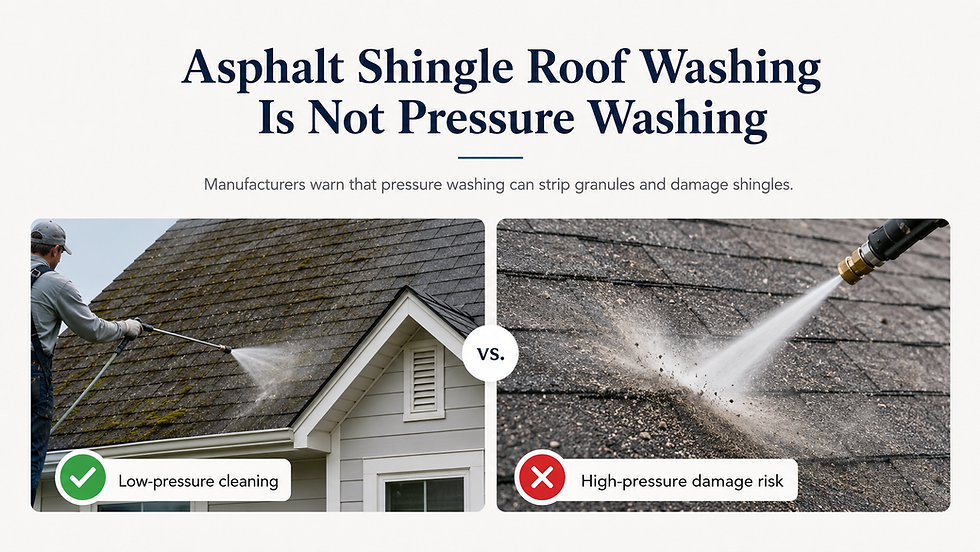
A proper roof wash is not about blasting shingles clean. It is about using a low-pressure, roof-appropriate cleaning process to treat organic growth while protecting the roof surface.
The Industry Standard: Clean the Roof Gently
The Asphalt Roofing Manufacturers Association, or ARMA, represents asphalt roofing manufacturers. Its roof cleaning guidance says the “most effective method” for cleaning algae and moss is a “50:50 mix of laundry strength liquid chlorine bleach and water.” [1]
ARMA also says the solution should be rinsed with “low pressure water.” [1]
That supports the basic idea behind soft washing: biological growth is treated chemically and gently, not removed by brute force.
ARMA’s warning is even more direct: “Never use a pressure washer." [1]
That one sentence matters.
Asphalt shingles are not concrete. High pressure can damage the roof surface, remove granules, and shorten the life of the roof. A professional roof wash should clean the roof without abusing the shingles.
GAF: Algae Can Be Cleaned, But Power Washing Can Damage Shingles
GAF identifies many dark roof stains as “blue-green algae.” [2]
GAF’s cleaning bulletin describes applying a cleaning solution with a garden sprayer, allowing dwell time, and rinsing with “low-pressure water.” [2]
GAF also warns that power washing “may dislodge granules,” which can lead to “premature shingle failure.” [2]
That is the entire roof washing argument in plain English: yes, the roof can be cleaned, but the method matters.
GAF’s moss guidance is just as strong. GAF says moss holds moisture, and retained water can “degrade shingles over time.” [3] GAF also warns that pressure washers can cause shingles to “lose their granules and lift.” [3]
That is not just a curb appeal issue. Granules protect shingles. Lifted shingles create openings. Moisture sitting on the roof season after season is not helping anything.
Owens Corning: Cleaning Supports Roof Performance
Owens Corning says routine maintenance tasks like cleaning shingles, keeping debris off the roof, and addressing moss or algae early can “support your roof’s ability to shed water and perform as intended.” [4]
That is exactly what a roof is supposed to do: shed water.
A roof covered in algae, moss, lichen, leaves, pine needles, and debris is not in its cleanest or best-draining condition. Organic buildup holds moisture. Debris blocks drainage. Moss can grow into shingle edges. Staining makes the roof look older and more neglected than it may really be.
Owens Corning also says “moss absorbs water” and can damage shingles by “raising the shingle edges.” [5]
Once moss starts lifting shingle edges, the issue has moved beyond appearance. Raised edges can expose areas that were meant to stay protected.
CertainTeed: Do Not Power Wash Asphalt Shingles
CertainTeed says asphalt shingles “can accumulate algae or moss.” [6]
CertainTeed also says: “Do not use a power washer.” [6]
Why? Because high-powered spray can “dislodge the roofing granules.” [6]
That is the key difference between roof washing and pressure washing.
CertainTeed is not saying algae and moss should be ignored. On another maintenance page, CertainTeed says to “use a roof cleaner to remove moss and algae.” [7]
That is exactly what professional roof washing is meant to do: use a roof-safe cleaning process to remove organic growth without stripping the protective surface from the shingles.
IKO: Moss Is a Functional Roof Problem
IKO is blunt about moss.
IKO says “moss growth can create several problems” on shingle roofs. [8]
IKO also warns that scrubbing moss can damage asphalt shingles and “remove their granules.” [9]
Pressure washing is not the answer either. IKO says pressure washers can “break a shingle’s adhesive and lift it up.” [9]
That is the danger zone. Moss can create roof problems, but aggressive removal can create roof problems too.
The right approach is careful treatment, low pressure, and realistic expectations. Algae may clean up quickly. Moss and lichen often die during treatment but release over time.
IKO also specifically mentions lichen, explaining that metal strips can help prevent “moss, algae and lichen.” [9]
That matters because lichen is often tougher and more stubborn than algae. It may stay bonded to the shingle surface after treatment and take longer to weather off.
TAMKO: Algae, Moss, and Discoloration Can Signal Trapped Moisture
TAMKO tells homeowners to look for “algae, moss, or discoloration” as signs of “trapped moisture.” [10]
Algae, moss, lichen, and discoloration are not always random cosmetic blemishes. They can be signs that part of the roof is staying damp, shaded, dirty, or poorly drained.
TAMKO also tells homeowners to avoid pressure washing and to use “a cleaner designed for roofing materials.” [10]
Again, the manufacturer message is consistent: address the growth, but clean the roof correctly.
Atlas: Gentle Cleaning Helps Protect the Roof and Warranty
Atlas Roofing directly addresses whether homeowners should clean black roof streaks.
Atlas says black streaks are caused by algae and recommends calling a contractor who can use “gentle cleaning methods.” [11]
Atlas also says those methods should not damage shingles or “void your warranty.” [11]
That is a strong reason not to experiment with a pressure washer, stiff brush, or random chemical mix on the roof.
A roof is too expensive to clean the wrong way.
Malarkey: Pressure Washing Can Dislodge Protective Granules
Malarkey Roofing Products recommends regular roof maintenance, including clearing leaves, twigs, and branches, cleaning gutters, and trimming overhanging trees. Malarkey says this helps prevent moisture buildup and reduces the likelihood of moss and algae growth. [12]
Malarkey also warns that pressure washing can “dislodge a shingle’s granules.” [12]
And those granules matter. Malarkey describes granules as the shingle’s “primary defense against damage and UV aging.” [12]
That is why roof washing should be low pressure. The goal is to treat the growth, not strip away the roof’s protective surface.
PABCO: Use Low Pressure for Algae and Moss
PABCO Roofing Products gives some of the clearest cleaning instructions of any manufacturer.
PABCO recommends treating algae with a “50:50 mix of liquid chlorine bleach and water.” [13]
For moss, PABCO says the solution should be applied with a “low-pressure sprayer.” [13]
PABCO also warns: “Do not use abrasive cleaning methods.” [13]
That is professional roof washing in a nutshell: the right solution, applied gently, with no aggressive scraping, brushing, brooming, or pressure washing.
PABCO also specifically discusses lichen. Their algae-resistant shingle article says “moss and lichen can trap moisture.” [14] They also says they can “redirect water flow” and “dislodge granules.” [14]
That is a serious statement from a shingle manufacturer. Lichen is not just an ugly crust on the roof. It can hold moisture, interfere with water flow, and disturb the granule surface as it spreads.

Warranty Language: What Homeowners Should Understand
This is where roof washing becomes even more important.
Most asphalt shingle warranties are not maintenance contracts. They usually cover manufacturing defects under specific conditions. They generally do not promise to cover every stain, growth, cleaning mistake, moisture issue, or roof problem caused by outside conditions.
Several manufacturers offer algae resistant warranties for blue-green algae staining. That is useful, but it does not mean the roof is protected against all moss, lichen, fungus, debris, pressure washing damage, or poor maintenance.
In fact, the warranty language often points the other direction.
GAF excludes discoloration or contamination caused by “fungus, mold, lichen, algae” except for covered blue-green algae on qualifying products. It also excludes contamination caused by “organic materials on the roof.” [15]
Owens Corning's warranty language excludes issues caused by growth such as “mold, lichen and green algae.” It also excludes damage from “power washing” and damage due to “debris, resins or drippings from foliage.” [16]
TAMKO has an “Algae Cleaning Limited Warranty,” which may provide cleaning-related coverage for qualifying algae staining. But TAMKO also excludes staining, discoloration, and damage from algae outside that warranty, plus “moss, fungus, overhanging trees” and other biological growth. [17]
Atlas warranties certain shingles against black streaks caused by blue-green algae, but their warranty excludes discoloration primarily caused by “green algae, lichen, moss, mold, mildew” and other contaminants. [18]
Malarkey’s warranty says it's algae warranties apply only to blue-green algae and exclude “lichens, moss” and other biological growths. It also excludes deterioration or distortion caused by “power washing” and biological materials. [19]
IKO’s limited algae resistance warranty applies to discoloration caused by blue-green algae on qualifying shingles and may provide cleaning related labor coverage under certain terms. [20]
The takeaway is simple: shingle warranties do not give homeowners a free pass to ignore roof growth or clean the roof aggressively.
Manufacturers know algae, moss, and lichen are real roof issues. They also expect roofs to be maintained and cleaned according to proper methods.
That makes professional low-pressure roof washing a smart maintenance decision, not just an appearance upgrade.
Asphalt Shingle Roof Washing Is Not Pressure Washing
This distinction matters more than anything else.
Pressure washing relies on force. It blasts the surface. On concrete, that may make sense. On asphalt shingles, it can be destructive.
Roof washing relies on treatment. The solution does the work. The pressure stays low. The goal is to kill algae, moss, and lichen without ripping away protective granules or forcing water under shingles.
A proper asphalt shingle roof wash should include:
Low-pressure application
A roof-appropriate cleaning solution
Controlled dwell time
Low-pressure rinsing when appropriate
Plant and landscape protection
Gutter and downspout awareness
No pressure washing
No scraping
No hard brushing
Realistic expectations for moss and lichen release
That is the difference between cleaning a roof and damaging one.
The Bottom Line
The major asphalt shingle manufacturers have already made the case for roof washing.
ARMA says algae and moss can be cleaned with bleach and water and says never to use a pressure washer.
GAF says power washing can dislodge granules and lead to premature shingle failure.
Owens Corning says cleaning shingles, keeping debris off the roof, and addressing moss or algae early supports the roof’s ability to shed water.
CertainTeed says asphalt shingles can accumulate algae or moss and tells homeowners not to use a power washer.
IKO says moss can create roof problems and that pressure washing can lift shingles.
TAMKO says algae, moss, and discoloration can be signs of trapped moisture.
Atlas recommends gentle cleaning methods that do not damage shingles or void the warranty.
Malarkey says pressure washing can dislodge protective granules.
PABCO recommends low-pressure treatment for algae and moss and says moss and lichen can trap moisture, redirect water flow, and dislodge granules.
So what do asphalt shingle manufacturers have to say about roof washing?
They say organic growth should be addressed.
They say pressure washing is the wrong method.
And they repeatedly point homeowners toward careful, low-pressure cleaning.
A clean roof is not just about curb appeal. It's about maintaining the shingles, protecting the roof surface, and helping the roof do what it was built to do:
Shed water. Protect the home. Last as long as possible.
Reference Table
# | Manufacturer / Source | Key Quote or Warranty Point | Link |
1 | ARMA | “50:50 mix of laundry strength liquid chlorine bleach and water”; “Never use a pressure washer.” | |
2 | GAF | “Low-pressure water”; power washing “may dislodge granules” and cause “premature shingle failure.” | |
3 | GAF | Moss moisture can “degrade shingles over time”; pressure washers can make shingles “lose their granules and lift.” | |
4 | Owens Corning | Cleaning shingles and addressing moss or algae early can “support your roof’s ability to shed water and perform as intended.” | |
5 | Owens Corning | “Moss absorbs water” and can damage shingles by “raising the shingle edges.” | |
6 | CertainTeed | Asphalt shingles “can accumulate algae or moss”; “Do not use a power washer.” | |
7 | CertainTeed | “Use a roof cleaner to remove moss and algae.” | |
8 | IKO | “Moss growth can create several problems.” | |
9 | IKO | Pressure washers can “break a shingle’s adhesive and lift it up”; prevention can target “moss, algae and lichen.” | |
10 | TAMKO | “Algae, moss, or discoloration” can be signs of “trapped moisture.” | |
11 | Atlas | Recommends “gentle cleaning methods” that do not damage shingles or “void your warranty.” | |
12 | Malarkey | Pressure washing can “dislodge a shingle’s granules”; granules are the “primary defense against damage and UV aging.” | |
13 | PABCO | Recommends a “50:50 mix of liquid chlorine bleach and water” and a “low-pressure sprayer.” | |
14 | PABCO | “Moss and lichen can trap moisture,” “redirect water flow,” and “dislodge granules.” | |
15 | GAF Warranty | Excludes discoloration or contamination from “fungus, mold, lichen, algae” except qualifying blue-green algae, plus “organic materials on the roof.” | |
16 | Owens Corning Warranty | Excludes “mold, lichen and green algae,” “power washing,” and damage from “debris, resins or drippings from foliage.” | |
17 | TAMKO Warranty | Includes an “Algae Cleaning Limited Warranty” but excludes issues from “moss, fungus, overhanging trees” and other biological growth. | |
18 | Atlas Warranty | Excludes discoloration primarily caused by “green algae, lichen, moss, mold, mildew” and other contaminants. | |
19 | Malarkey Warranty | Excludes “lichens, moss” and other biological growths; excludes damage from “power washing.” | |
20 | IKO Warranty | Limited algae resistance warranty applies to blue-green algae discoloration and may provide cleaning-related labor coverage under warranty terms. | |
21 | PABCO Algae Defender | Says proper roof maintenance helps mitigate moss and lichen growth. |
